
State Fair memories last a lifetime
August 2026
Vintage Discoveries
State Fair memories last a lifetime
by Ken Weyand
Growing up in northeast Missouri, I recall that our farm family visited both the Missouri and Iowa state fairs. Unlike neighboring dairy farmers, whose work kept them at home, we were able to take summer road trips when our corn and soybeans fields were cultivated, or “laid by,” as we called it.
My earliest memories of the Missouri State Fair go back to 1945, when I was 8. At the time of our visit, the fair had recently opened after being closed during World War II. My parents and I stayed east of the Fairgrounds at a nearby home, whose owner offered rooms during the event. I remember our visit covered only a couple of days before we left to attend a family reunion in Illinois.
I remember sampling a “Corn Dog,” that may have been introduced a few years earlier, but was a new treat for me. My family visited a cattle barn, where my dad knew some of the exhibitors, and I remember a building that featured a lot of homegrown produce. I’m not sure if we attended a grandstand show, but I remember seeing motorcycle racing, featured the day we were there.
One of my personal favorites was a traveling show of a miniature farmstead. Located in a special tent, the exhibit featured a variety of tiny vehicles and implements, animated by small motors and levers, and illuminated by tiny electric lights. I think the admission price was 25 cents.
The next year we visited the Iowa State Fair in Des Moines and stayed at the campgrounds. Our “tent” was a tarpaulin erected over our old Chevy, and we slept on army-surplus cots.
Keeping with a long tradition, we were serenaded for at least an hour by neighboring campers “calling their hogs.”
On the fairgrounds, we had breakfast in a building not far from the cattle barn. My dad took a special interest in the beef cattle judging, while my mom, a “city girl” with a musical background, preferred to attend the performances of high school bands in a bandstand located in a tree-covered park.
I recall buying vanilla ice cream in a cup from a vendor. The treat came with a small wooden spoon, which worked fine after the ice cream melted a bit and became soft enough for the spoon to work. I think it cost a dime.
I was barely old enough to explore the fairgrounds on my own. I remember visiting the displays of new farm equipment, captivated by the bright colors and the smell of the new rubber tires. One of the exhibitors was Inter-national Harvester, which introduced their new Cub, the smallest of the line. Kids were allowed to “drive” a demonstrator tractor around a small area, with an adult hovering over them to avoid any miscues. I remember it was fun, but a bit insulting to a kid who considered himself an expert tractor driver.
The big attraction that year was a tent featuring the newly-introduced Tucker automobile. Seeing it required standing in a long line, but it was worth the wait, as the car was sleek and unique, with its trio of headlights, padded dash, and other features. Unfortunately, the Tucker never made it to full production. But viewing the prototype in the tent was a treat for all the “car experts,” including me.
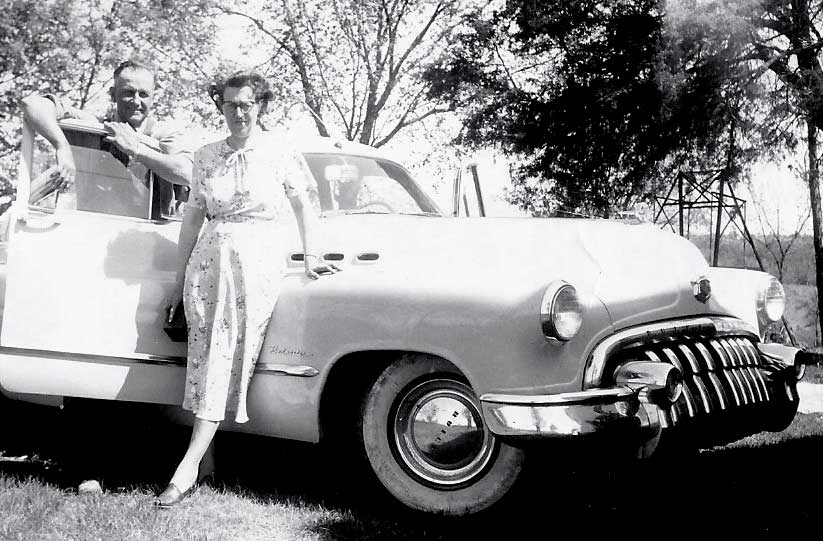
Ken’s parents, Elmer and Mabel Weyand, and their 1950 Buick. (Images courtesy of the author)
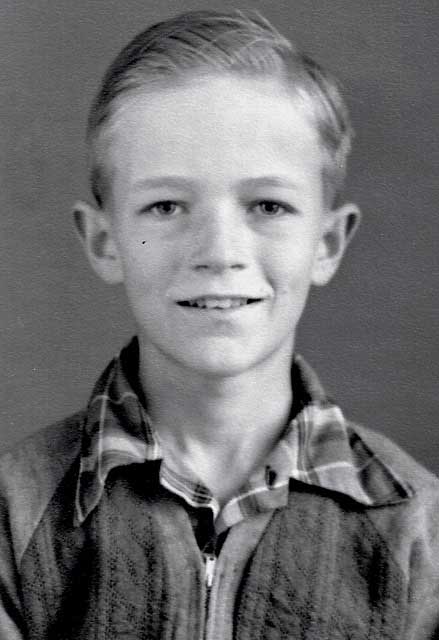
Ken in 1950
In 1950, my parents and I visited the Iowa fair in our new Buck Roadmaster. The car was a great improvement over our ancient Chevy that survived the war, and my dad took every opportunity to take a road trip.
Again, we stayed at the campground. We still had our tarp and army-surplus cots. But the Buick’s huge trunk offered a comfortable alternative for me. Using a blanket and a sleeping bag, I spent my night in the trunk.
The big feature that year was a visit by Sally Rand, the famed burlesque performer, on the Midway. Her special act included her famous fan dance. Unfortunately for me, I was below the age limit and had to content myself with watching her make a brief appearance on a small stage at the front of the tent. I consoled myself by taking extra rides on my favorite concession, the Bumper Cars.
On this trip, I saw a barker giving a demonstration of a “magic mouse” in one of the exhibit buildings. The small mouse seemed to race across his arms as he waved them in front of his chest, impressing the small crowd that gathered. In reality, the “mouse” was tethered to his shirt button by a near-invisible thread, and he waved his arms to create the illusion. I spent 50 cents and bought one.
After we got home, I went to our County Seat town with my dad, who had some business at the court house. While he was inside, I sat on a park bench and practiced with my “Magic Mouse.” I remember attracting a small group of spectators, who were duly impressed. It made the 50-
cent investment well worth it.
(A version of the “Iowa State Fair” portion of the above column (along with my article on family history) will appear in the December issue of “Voices from the Prairie,” an online biennial publication of Humanities Iowa. Go to humanitiesiowa.org. – KW)
Ken Weyand is the original owner/publisher of Discover Vintage America, founded in July 1973 under the name of Discover North.
Ken Weyand can be contacted at kweyand1@kc.rr.com Ken is self-publishing a series of non-fiction E-books. Go to www.smashwords.com and enter Ken Weyand in the search box.
Visit to threshers’ show brings back ‘farm memories’
September 2023 Vintage Discoveries Visit to threshers’ show brings back ‘farm memories’ by Ken Weyand As a farm kid who grew up in the days when farmers were transitioning from horse-drawn equipment to tractors, a part of my brain still remembers when a threshing…
Old recipe book shows how business plans can change
July 2023 Vintage Discoveries Old recipe book shows how business plans can change by Ken Weyand A comb-bound book was recently unearthed among my old files – a reminder of how far Discover Vintage America has come since my fledgling efforts as a journalist/publisher…
Old coloring book recalls WWII
June 2023 Vintage Discoveries Old coloring book recalls WWII by Ken Weyand One of the items I’ve saved from my childhood is a coloring book, and its subject matter makes it a bit special. “Fighting Yanks” measures 11 x 14 inches, with a full-color display of…
1900 ‘Health Book’ advised rural families what to do before the doctor comes
May 2023 Vintage Discoveries 1900 ‘Health Book’ advised rural families what to do before the doctor comes by Ken Weyand Wealth of healthy living advice in 1900 A small hardbound book, part of my family’s accumulation of “old stuff,” contains a wealth of healthy…
One of my Dad’s treasures was unique ‘Chatterbox’ book
April 2023 Vintage Discoveries One of my Dad’s treasures was unique ‘Chatterbox’ book by Ken Weyand Childhood Books As an impoverished orphan in 1900, my dad had few possessions. Luckily, his older sisters supplied him with a few books and other items that helped him…
Old tennis racket shows how much sport has changed
March 2023 Vintage Discoveries Old tennis racket shows how much sport has changed by Ken Weyand Old tennis racket Since I was a youngster, an old tennis racket has been part of our family’s collection of “never thrown-away treasures.” One of the few sporting items…
Riding crop recalls days when horses ruled the roads
February 2023 Vintage Discoveries Riding crop recalls days when horses ruled the roads by Ken Weyand Antique Riding Crop Nearly forgotten among the “family artifacts” packed away in our house was an ancient riding crop once used by my grandmother. At least that’s…
Old top was a favorite in the 1940s toy box
December 2022 Vintage Discoveries Old top was a favorite in the 1940s toy box by Ken Weyand Toys of yesteryear Many of today’s youngsters take little interest in the toys of yesteryear. Devoid of today’s electronics and high-tech gadgetry, and handcrafted from basic…
Baby shoes from the 1880’s recall some sad family history
November 2022 Vintage Discoveries Baby shoes from the 1880’s recall some sad family history by Ken Weyand My dad often referred to his seven siblings when recalling how the family split up when their parents died, and they were “farmed out” in 1900 to various aunts…
Terracotta figurines survived rugged European trip – and more
October 2022 Vintage Discoveries Terracotta figurines survived rugged European trip – and more by Ken Weyand Some vintage items bring back a lot of memories. In 1953, I had the good fortune of traveling in Europe with the director of the Apollo Boys Choir. As a…
Mementos of a trip to Paris: 1921-22
September 2022 Vintage Discoveries Mementos of a trip to Paris: 1921-22 by Ken Weyand Sailing on the Aquitania My aunt, Ruth May Weyand, was the youngest of eight siblings orphaned in 1899 and farmed out to various relatives. By 1917, she had graduated from Illinois…
Picture book was a 1917 railroad souvenir
August 2022 Vintage Discoveries Picture book was a 1917 railroad souvenir by Ken Weyand Rocky Mountain Views One of my relatives who traveled through the Western states by rail in the early 1900s came home with a souvenir book of “Rocky Mountain Views. The origin of…